


Here’s the reality: mobile gaming in 2026 isn’t just bigger—it’s fundamentally different.
We’re looking at $98 billion in revenue and 3.5 billion players worldwide. But here’s what matters more: the old playbook doesn’t work anymore. User acquisition costs hit record highs in late 2024, and downloads keep declining while revenue grows. That’s not a contradiction—it’s the new normal.
Mobile gaming trends 2026 reveal a market that’s matured past the land-grab phase. Publishers who win aren’t the ones spending the most on UA. They’re the ones leveraging neural networks to acquire better users, not just more users. And if you’re still running campaigns the traditional way? You’re already behind.
Let’s break down what’s actually happening and what you need to do about it.

Understanding mobile gaming trends 2026 starts with this counterintuitive fact: downloads are down 6-7% year-over-year since 2021, but revenue keeps climbing. In-app purchase revenue grew 4% annually. Time spent is up 8%. Sessions are up 12%.
What’s going on? The market’s maturing. Publishers finally figured out that install volume is a vanity metric.
Global mobile gaming revenue hits $98 billion in 2026. The U.S. alone accounts for $33 billion of that. But here’s what changed: the money’s coming from fewer, better players who stick around longer and spend more. That shift changes everything about how you should approach UA.
Strategy games still dominate at $17.5 billion (4X strategy leads the pack). RPGs follow at $16.8 billion, though they’re struggling with bloated production costs and player burnout. And puzzle games? Still printing money at $12.2 billion—don’t sleep on casual players.
But here’s the uncomfortable truth about 2026: market concentration is brutal. In some subgenres, the top two games control 80%+ of revenue. Roblox owns sandbox. Clash of Clans still dominates base-building. Honor of Kings remains the mid-core king.
New hits like Monopoly GO didn’t win by taking share from competitors. They expanded the category entirely—new IP, new audience, nostalgic packaging. Same with Whiteout Survival and Last War: Survival. They streamlined 4X strategy and made it work globally with universally appealing creatives.
If you’re trying to dethrone an incumbent with a slightly better game? Good luck. Category expansion is the only realistic path to massive scale in 2026.

Casino and iGaming titles represent a major revenue driver often overlooked in broader mobile gaming discussions. The category generated $11.7 billion in 2024, and it’s not slowing down.
What makes iGaming interesting for mobile gaming trends 2026? It’s a different beast than traditional F2P mobile games.
Higher ARPU across the board – Players willing to wager real money demonstrate significantly higher average revenue per user compared to standard F2P titles. We’re talking multiples, not percentages.
Regulatory moats protect established players – Licensing requirements and compliance frameworks create natural barriers to entry. You can’t just launch an iGaming app and start acquiring users—you need licenses, payment processing infrastructure, responsible gaming controls, and legal teams. That complexity protects incumbents from the constant competitive pressure other mobile game categories face.
Retention through habit formation – Daily login mechanics, progressive jackpots, tournament structures, and social competition features drive exceptional retention rates in well-designed iGaming titles. The psychology of near-misses and intermittent rewards creates engagement patterns that most casual games can’t match.
Perfect fit for older demographics – Remember that older adult segment with high LTV we discussed? They’re prime iGaming users. Comfortable with real-money wagering, disposable income, preference for familiar casino game mechanics, and time to engage regularly.
UA challenges are unique – i
iGaming faces stricter advertising restrictions across platforms, making user acquisition more complex and expensive. But that same restriction means less competition for ad inventory in certain channels. Smart iGaming marketers who master compliant creative and targeting have significant advantages.
iGaming encompasses real-money gaming including sports betting, online casino, poker, and daily fantasy sports. Social casino games (free-to-play with virtual currency) represent a separate category with different regulatory requirements and monetization models.
For publishers considering entering iGaming or expanding existing operations, 2026 represents a critical inflection point. Markets like the U.S. continue opening up state-by-state for sports betting and online casino. But the window for easy entry is closing as established operators consolidate market share and build brand recognition.

Among the most transformative mobile gaming trends 2026, neural networks aren’t just improving user acquisition—they’re completely rewriting the rules.
When CPIs jumped significantly in late 2024, publishers had two choices: accept lower ROAS or get smarter about targeting. Neural networks became the answer because they do something traditional ML can’t: they process billions of data points across hundreds of variables and find patterns humans would never spot.
Here’s what that looks like in practice. A deep neural network analyzes a bid request in milliseconds. It’s looking at device type, location, behavioral signals, in-app history, time of day, demographic data—and it’s calculating the exact LTV probability for that specific user. Then it bids accordingly.
Traditional programmatic? It uses rules. “If user matches X demographic in Y location, bid Z amount.” That works, but it’s crude. Neural networks understand context and nuance in ways rule-based systems can’t touch.
Let’s get specific about capabilities:
Predictive LTV modeling – Instead of waiting weeks to see if a user converts, neural networks predict lifetime value at the impression level. You’re not buying installs anymore. You’re buying predicted LTV.
Real-time creative optimization – The network sees which creative elements perform for which user types and adjusts on the fly. No more waiting for A/B tests to reach significance.
Lookalike audience generation – But actually good this time. Neural networks analyze behavioral patterns and demographic data from your best users and find similar users with scary accuracy.
Causal reasoning – This is huge. Neural networks don’t just find correlations (which can be meaningless). They’re starting to understand actual cause-and-effect relationships in UA and retention.
Fraud detection – Invalid traffic is expensive. Neural networks spot bot patterns and click farms way better than traditional filters.
Publishers using neural network-powered DSPs are seeing significantly lower acquisition costs for high-LTV users—some reporting reductions of 20% or more. Not just lower CPIs—lower costs for users who actually matter.
Why? Because the optimization happens across multiple dimensions simultaneously. Creative elements, audience targeting, bidding strategies, timing—all optimized together instead of in isolation. The effects compound.
And here’s the gap that’s opening up: if you’re running traditional UA while your competitors use neural networks, you’re not just a little behind. You’re competing with fundamentally superior intelligence. That gap widens every month.
The creative production bottleneck used to limit how fast you could test. Not anymore.
Generative AI now produces thousands of creative variations automatically. Neural networks test them across audience segments and predict emotional responses before you spend a dollar on media. The velocity is insane compared to manual creative production.
What this enables:
If you’re still designing creatives one at a time and waiting weeks for test results, you’re playing a different game than your AI-powered competitors.
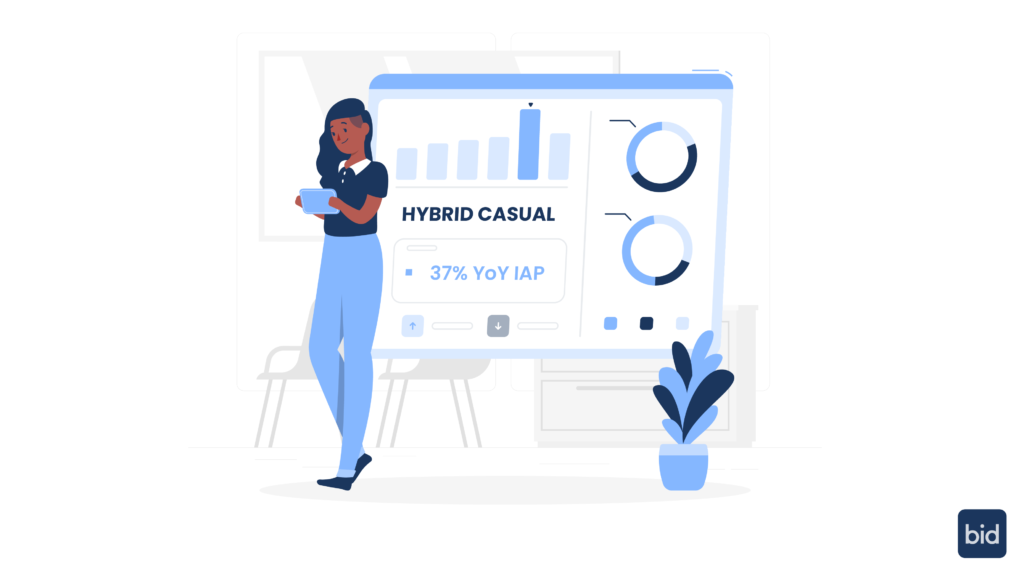
Hybrid casual games are one of the hottest mobile gaming trends 2026, and the numbers don’t lie—37% YoY IAP revenue growth in 2024. No other category comes close.
What makes hybrid casual work? Simple core loop (anyone can play immediately) plus meta-progression systems (reasons to keep playing and spending). Think hyper-casual accessibility meets mid-core monetization depth.
The formula:
But here’s where it gets interesting for mobile gaming trends 2026. Mid-core and hardcore publishers are now stealing this hybrid approach. RPG + simulation. Tower defense + idle. Match-3 + narrative. When your core genre’s saturated, hybrid mechanics let you create something fresh without reinventing the wheel.

AI isn’t just helping with UA anymore. It’s becoming a co-creator in game development itself.
By 2026, generative AI systems design levels, animate characters, compose adaptive music, and tune difficulty curves in real time. Games that evolve continuously and deliver unique experiences tailored to each player aren’t science fiction—they’re shipping now.
AI-native workflows can cut production timelines by up to 40% while creating way more content variety. Studios use ML to automate asset creation, level design, and QA. Human talent focuses on creative direction and innovation instead of repetitive implementation work.
The democratization angle matters too. Smaller studios can now compete with production values that used to require massive art and design teams. Generative AI creates infinite variations of environments, characters, and narrative elements.
Remember when LiveOps meant a fixed event calendar? That’s dead.
AI-driven LiveOps analyzes player sentiment, location, and behavior patterns to schedule customized challenges. The system adjusts content releases and difficulty based on how individual players interact. Early data suggests this can boost retention and session time by as much as 40% in some cases.
What intelligent LiveOps enables:

Cross-platform capabilities are among the most impactful mobile gaming trends 2026. Players don’t just want it anymore—they expect it.
The tipping point hit in 2025. Now players expect seamless experiences across mobile, PC, console, web, and streaming. Your game needs to work everywhere with unified progression. That’s not a premium feature. It’s table stakes.
5G networks plus mature cloud gaming platforms eliminated the old barriers between mobile and console experiences. Players can enjoy graphically intensive titles on mobile without compromise because the heavy processing happens server-side.
But this creates infrastructure demands. You need scalable backends, unified identity management, and real-time cross-device syncing. Publishers who didn’t architect for multi-platform from day one are scrambling to retrofit.
Cross-platform expands your addressable market but complicates monetization. You’re balancing platform-specific revenue shares, payment processing fees, and UA costs across multiple storefronts. The payoff? Unified player pools dramatically improve matchmaking and social connectivity.

Apple’s App Tracking Transparency (ATT) and evolving privacy regulations aren’t going away. Deterministic attribution is dead. Publishers who adapted early have the advantage.
Modern attribution uses probabilistic modeling, incremental testing, and media mix modeling. Neural networks trained on aggregated conversion data can predict campaign effectiveness and optimize spend allocation without individual user identification.
Smart publishers invest heavily in owned media and DTC storefronts. First-party data becomes your competitive moat. Plus you capture incremental revenue by avoiding platform fees.
Contextual targeting evolved beyond keyword matching. AI systems use computer vision and NLP to analyze creative content and surrounding context. You can deliver relevant ads without tracking individual users—privacy-compliant personalization that actually works.

Market saturation in core demographics is driving publishers toward historically underserved segments. Young female gamers and older adults represent chronically underrepresented audiences with serious spending potential.
Female players show strong preferences for narrative-driven experiences, social cooperation mechanics, and creative expression systems. Match-3 puzzle games combined with narrative progression and simulation genres continue crushing it with female audiences. Importantly, female players often exhibit higher retention rates and more consistent spending patterns than male-dominated categories.
Older adults represent the high-LTV segment nobody talks about. Demographic aging in developed markets creates rapidly growing cohorts comfortable with mobile tech and possessing substantial discretionary income. This segment gravitates toward puzzle games, word games, and social casino experiences—demonstrating exceptional lifetime value with higher willingness to spend on convenience.

Brand collaborations and IP crossovers have trended significantly upward. Roblox leads the charge with partnerships spanning entertainment, fashion, and consumer brands—Netflix, Mattel, major music artists.
The next evolution? Collaborations across gaming IP itself. Cross-promotional opportunities introduce players to new experiences through familiar characters and mechanics. This serves dual purposes: acquiring new players through trusted IP while providing fresh content that re-engages existing audiences.
Successful IP collaborations maintain authentic integration rather than superficial licensing—embedding partner IP into core gameplay loops creates substantive player value beyond cosmetic additions.

Mobile game monetization continues evolving toward hybrid models blending multiple revenue streams. Modern games typically implement: in-app purchases for progression, rewarded video ads providing optional value, premium battle passes, and subscription offerings.
This diversification maximizes addressable audience by providing monetization pathways matching different player preferences and spending capabilities. Data-driven personalization enables publishers to surface appropriate opportunities based on individual behavior without overwhelming players.
Regulatory pressure around loot boxes, gacha mechanics, and manipulative design patterns is intensifying globally. Forward-looking publishers proactively implement ethical safeguards including spending limits, cooling-off periods, and transparent odds disclosure.
Systems deployed for monetization optimization must incorporate ethical constraints preventing exploitation of vulnerable players. Advanced systems can identify problematic spending patterns and automatically implement protective interventions.
Success navigating mobile gaming trends 2026 requires embracing technological sophistication while maintaining focus on player experience.
Invest in AI Infrastructure – Organizations lacking sophisticated AI capabilities face widening performance gaps. Priority areas: predictive LTV modeling, generative AI for creative production, dynamic LiveOps, automated bidding, and churn prediction systems.
Focus on Category Expansion – Market concentration makes direct competition against incumbents futile. Success stories like Monopoly GO and Whiteout Survival demonstrate that category expansion offers more viable paths to scale.
Emphasize Retention Over Volume – Declining downloads coupled with growing revenue demonstrate industry maturation toward quality over quantity. Build games worth returning to repeatedly.
Design for Cross-Platform from Day One – Platform-agnostic gameplay has transitioned from premium feature to baseline expectation. Architecting for multi-device requires fundamental design decisions that can’t be retrofitted.
Target Underserved Demographics – Saturation in core demographics creates opportunity in female players, older adults, and emerging markets. These audiences often exhibit superior retention while facing less competition.

Mobile gaming trends 2026 reveal a sophisticated ecosystem where technological capability and strategic sophistication determine competitive outcomes. Neural networks and AI have transformed from experimental technologies into foundational requirements.
Success demands balancing multiple dimensions: leveraging advanced AI infrastructure while maintaining authentic player relationships, pursuing growth while implementing ethical safeguards, optimizing monetization while delivering genuine value.
Publishers mastering this complexity will capture disproportionate share of a market projected to exceed $98 billion in 2026. The convergence of neural network-powered marketing, AI-native development, and cross-platform infrastructure creates unprecedented opportunity for organizations prepared to embrace transformation.
For mobile game publishers seeking to thrive, the imperative is clear: invest in AI capabilities, prioritize sustainable player relationships, and architect experiences that transcend platform boundaries. The future belongs to organizations combining technological innovation with authentic understanding of player needs.
The mobile gaming trends 2026 are clear: AI-powered user acquisition isn’t optional anymore. It’s the difference between profitable growth and burning budget on the wrong users.
Bigabid’s neural network-powered platform is purpose-built for mobile game publishers who need to acquire high-LTV users at scale. Our deep learning infrastructure processes billions of data points daily to predict user lifetime value at the impression level, optimize creative performance in real-time, and maximize ROAS across your UA campaigns.
Whether you’re scaling a hybrid casual hit, launching an RPG, growing an iGaming app, or expanding into new markets—Bigabid’s AI gives you the targeting precision and creative intelligence that traditional DSPs can’t match.
Here’s what mobile game publishers get with Bigabid:
Stop competing with one hand tied behind your back. While your competitors leverage neural networks to acquire better users for less, you can’t afford to run traditional UA strategies.
Talk to our mobile gaming specialists to see how Bigabid can reduce your CPI while improving user quality.