


Bigabid Research | 7 min read | Sept 2026

What actually brings a churned user back: seeing your game, or playing it?
In an ad landscape dominated by noise, getting attention is half the battle. Most retargeting creative settles for being seen. Videos and banners keep your game visible at scale, and that presence matters. Interactive formats do the second thing. They put a moment of play inside the ad itself: three tiles matched, a level cleared, a win in fifteen seconds. That earns a different quality of attention, and it brings a churned user back through direct interaction rather than reminder alone. They aren’t watching your ad. They’re playing it.
And that works because of one thing your churned users have that net-new users don’t: memory.
A user acquisition ad has to introduce your game. A retargeting ad only has to remind. The payoff for reminding well is real: apps that run remarketing see an 85% uplift in week 12 retention compared to apps that don’t (AppsFlyer retention benchmarks; primarily Android).
Your churned users already know the mechanics, the characters, and the feeling of a win streak. An interactive ad doesn’t teach them anything new. When it’s built on your own game, it gives them thirty seconds of familiar gameplay, and that recreates the experience of playing instead of describing it.
That’s why the format mix matters more in retargeting than anywhere else. Videos and banners remind a churned user your game exists. A playable lets them feel why they liked it. The strongest retargeting campaigns run both, each doing the job it’s built for.
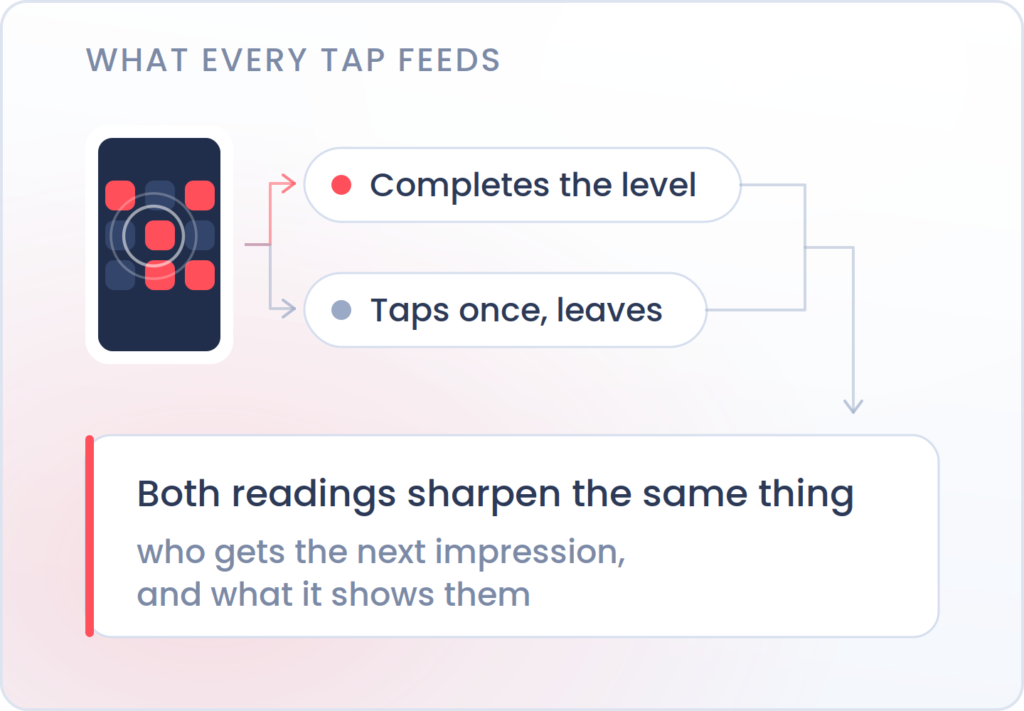
Here’s the part that gets less attention. Every tap inside an interactive ad tells you something a view never will.
A user who completes a mini-level built on your core loop is telling you they still enjoy that loop. A user who taps once and leaves is telling you something too. Both signals sharpen who gets the next impression and what it shows them, across every format you run, videos and banners included. In retargeting, data is the whole game, and interactive formats generate a kind of it nothing else does.
Most of the industry conversation about interactive formats happens around user acquisition. The retargeting upside is still under-discussed, which is exactly why it’s worth testing now.
A short, self-contained interactive moment inside the ad. For churned users, the strongest versions preview what changed since they left: a new mode, a new event, a new character. “Come back” is weaker than “look what you missed.”
The interactive card that appears after a video completes. The video re-creates the mood, the end card re-creates the habit. You get the storytelling of video and the muscle memory of play in one impression.
Video that pauses and asks the user to make a choice. Lower production cost than a full playable, and the choice itself is a targeting signal.
A playable doesn’t have to be your game. Some of the best performers are a mechanic that works on its own: a quick match, a pull-the-pin puzzle, a choice with a satisfying payoff. That is a real option and it often wins on engagement. It just buys you something different. The closer the mechanic sits to your actual core loop, the more the interaction tells you about intent in your game. The further away it sits, the more you are learning whether people enjoyed the mini-game.
And interactive doesn’t have to mean a full gameplay build. A single choice, a tap-to-reveal, or a quick match mechanic costs a fraction of a full playable and still produces the two things that matter: a moment of play and an interaction signal. Start light, then invest in full playables where the light versions prove the appetite.
This isn’t only a DSP talking point. AppsFlyer’s own re-engagement guidance recommends interactive formats like playables for winning back churned users, and its case data shows why: a travel app that re-engaged users with gamified scratch-card ads saw a 15% incremental lift in purchases in the months that followed (AppsFlyer).
Run interactive against your current static and video set, same audiences, same flights, and compare on these:
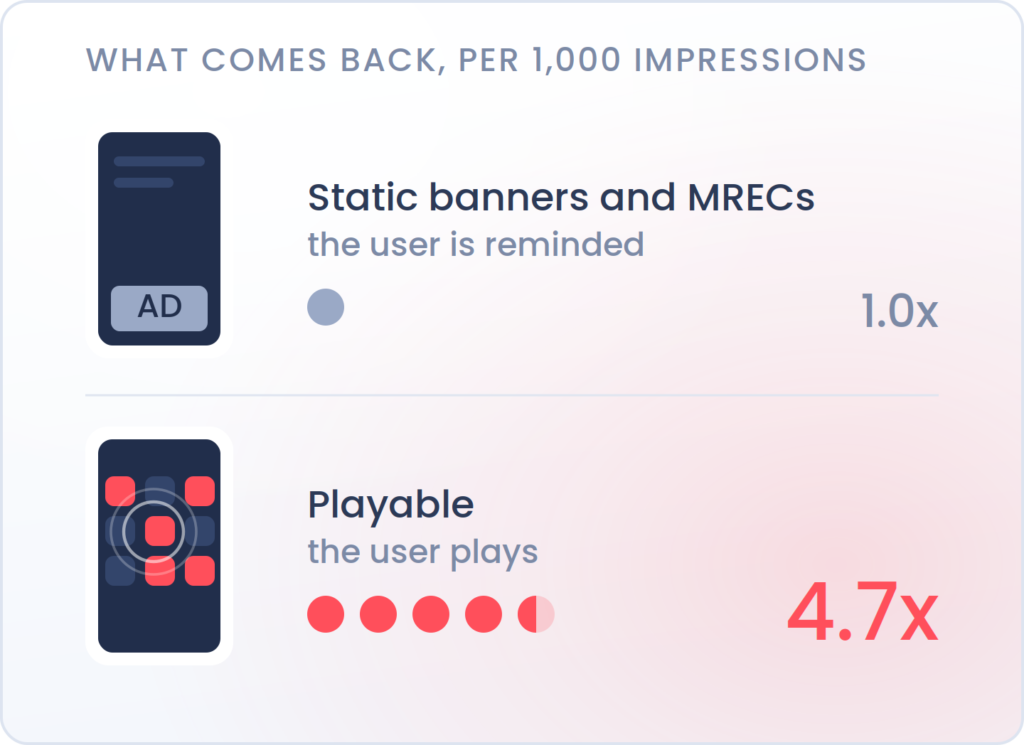
One caution: interactive formats often carry a higher CPM than banners or MRECs. Judge every format on cost per re-engaged user, not on media price. At that level the mix usually earns its place: banners for efficient presence, interactive for the moments that decide a comeback.
Videos and banners keep your game present. Interactive creative lets churned users play, and turns every tap into targeting signal at the same time. That double effect, better experience plus better data, is why adding interactive to the mix shows up in outcomes and not just in engagement charts.
The real question isn’t whether interactive formats work. It’s whether they work on your users, and a properly measured four-week test answers that.
Want the full testing framework, including the segment checklist and the questions to ask any retargeting partner before you sign? Get full access to RT 101, the retargeting course.
The segment checklist, and the questions to ask any retargeting partner before you sign.