

I’ve worked as part of many different creative teams in the past twenty years, and I can tell you that working in the creative department at a DSP is quite a bit different from any other environment.
Previously, I’ve worked at Meta, for several TV channels and also a fintech company. So it’s fair to say that I have a lot of experience! But when I arrived at Bigabid, the focus on using data to inform so much of what we do – that was something very new to me. Now, I couldn’t imagine working in any other way.
On the creative team we have four designers, who handle both graphic design and also motion graphics. One of the team acts as the project manager, distributing the tasks that come in and managing the deliverables. I’d say we are a small but very fine-tuned team.
When working with customers on their campaigns, how do you decide what creative is actually going to work?
Our whole creative process really starts and ends with data. Because we’re running thousands of ads across the platform, the team gets this unique, high-level view of what’s actually moving the needle. So, when we produce the creatives for a client, we aren’t guessing, we’re delivering assets that we already know are likely to win.
Because of this, all the creative designers at Bigabid are also experts in campaign performance. This means we can work directly with the data our platform shows us, rather than relying on a UA manager to come and tell us how the creatives need to be changed or improved.
Of course, this doesn’t mean that everything we do is 100% dictated by the data. Actually, we have a 90/10 rule. 90% of our tasks are strictly data-driven to ensure performance, but 10% of the time I’m telling the team, come up with the stupidest idea that you can, or come or the funniest idea that you can. Sometimes this works, and most of the time it doesn’t! But sometimes great ideas seem to come from nowhere, and we need to stay open to trying new things and taking creative risks.
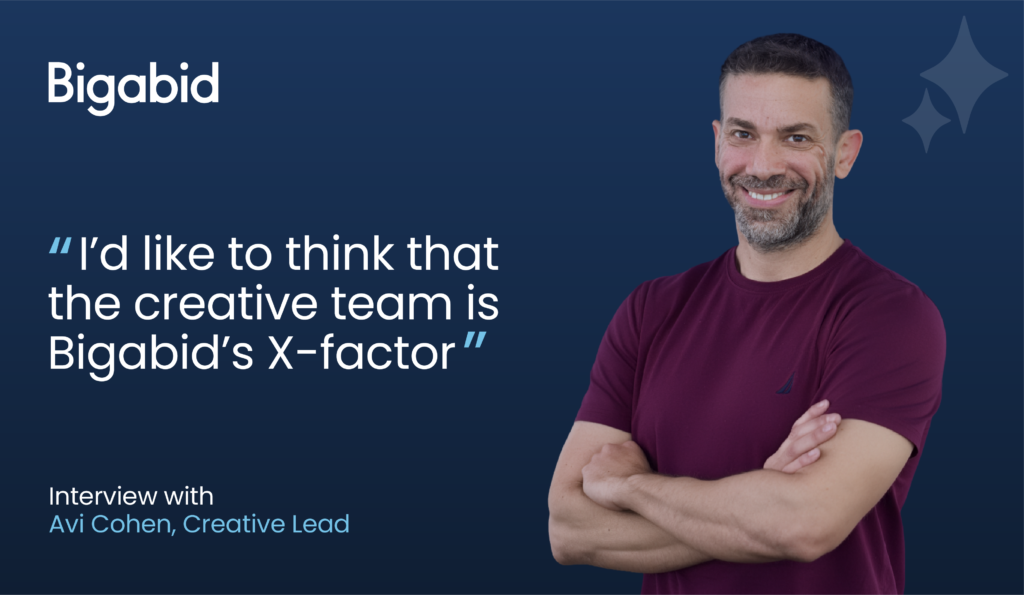
Every month, we go over all the creative that we produced in the previous months and we see how they performed, what performed well, what didn’t work, what worked well and why, and we try to get the insights and learn from the work we’ve done. I think this is another area where we are very different from most other creative departments. I’d like to think that the creative team is Bigabid’s X-factor.
We aren’t just using AI to churn out variations on the same creative. We’ve built an automated AI workflow engine that goes through the data, watches the best performing ads, and breaks down the elements of what has made that ad or campaign the most successful. From there, it generates its own prompt, pulls the client-approved assets, and builds the final creative. That’s when we bring back the human element, using our judgment and experience as a final step, checking for brand safety, things like that. So even when we are creating an AI production workflow, it’s based on data and real insight, with human oversight.
The majority of our customers work with the team. I know that for some DSPs using the in-house creative team is reserved for premium or high spending clients, but the approach we take is that it’s free for all of our customers. It might seem like we do this as an incentive to work with us, but really it goes back to the way we use data to underpin the creatives. We know that often our creatives will outperform anything that our customers come to us with, simply because we are able to leverage our own data to know exactly what will perform the best.
For example, we really wanted to be able to show the difference our approach makes, so we analyzed our 2025 data comparing our in-house creatives against those supplied by clients. The results were significant: our UA video campaigns achieved a 53% Day 7 ROI and a 52.6% IPM, while our RT video assets delivered a 38% Day 7 ROI and an 18.6% IPM. This is a big increase, and it’s down to the way we use data to understand what works.
I think the main difference is because when our clients pre-produce their ads themselves, they are usually designing them to run across many different platforms like Facebook, Google, YouTube, TikTok and across different DSPs. It’s very hard to create one single ad that can perform well in all of those, because each platform has a different audience with different behaviors, so and the user experience is different. In contrast, we know our creatives will only appear on our platform, so we can focus on optimising every element.
We do have a few customers that come to us with their own creatives, but that’s generally down to restrictions such as they are using licensed IP, or there is some kind of contractual reason why the creatives can’t be changed. But that’s a tiny minority really.
I’ve always believed in starting wider before thinking about such small changes. You need to test totally different concepts first to understand what your user actually relates to, and then iterate and improve.
Think about it: if you can come up with multiple concepts, and then iterate on each of them, you are increasing the total number of creative variations you are getting in front of consumers. Yes, it’s about quality and knowing what will engage people and the best time to show them an advert, but it’s also a numbers game. If I can have 200 creatives rather than 100, then I’m increasing my chances of success.
This is where AI can be a positive help, as we are combining the data with this iterative process at scale. We can experiment with every element of the ad, from the length to the style, whether we are using UCG, you name it – and then we can use the data to refine, improve and iterate at scale.
It’s an approach called deterministic creative engineering, where you are combining the kind of predictable iteration and testing that we are all familiar with, with the innovative and creative ideas you can achieve with generative AI.
Actually, they’re the ones who benefit the most. We work with some of the biggest names, like Playtika, Zynga, Playrix and Dream. When you’ve been running campaigns for a long time, you can hit a ‘glass ceiling’ where nothing feels new. But if you can look deep into the data we have, we can help them find that next level of performance they couldn’t see themselves.
Firstly, you are always trying to innovate in some way, because there are so many competitors and so many DSPs and so many platforms and so many opportunities. So if you are not trying to innovate and improve, you’ll just be left behind.
Plus, you always have the challenge of user fatigue, which is high and seems to be getting higher. There are so many things competing for attention that we need to come up with new formats and new ways to break through that attention barrier. Our data-led approach is a big help for this, but there will always be some kind of creative idea out of the blue that gives you a leap forward.
Technology-wise, I think there are definitely things on the horizon we can’t even think about or imagine right now. Technology changes so quickly, and the way we approach ad creative is changing all the time. AI is definitely going to be a big thing. Maybe it will lead to ad formats that are more interactive, or which change as you experience them. Or maybe every user gets their own totally unique version of an ad, so no two users ever see the same thing. It’s hard to know what will be possible even in the near future!
Yeah, that’s the biggest thing – AI is going to elevate the industry, it’s just a question of how quickly.
Ready to take your campaign creatives to the next level? Reach out to Bigabid for expert guidance on optimizing your app’s user acquisition and retention strategies. Let us help you create campaigns that don’t just drive downloads, but build lasting relationships with your users.